
 English






- Packaging & Labels
- Packaging Box
- Mono Carton Box
- Corrugated Box
- Sleeve for Box
- Giftbox
- Labels
- Roll Labels
- Sheet Label
- Kraft Labels
- Custom Tape
- Custom Packing Tap
- Custom Security Tape
- Silicon Tape
- Packaging Pouches
- Paper Standee Pouches
- Kraft Standee Pouches
- Packaging Accessories
- Tags
- Thank You Cards
- Door Hangers
- Packing bag






Why Indian Printing Needs a New Business Model | Raghav Gupta (Softberry) & Parmeshwar Patidar
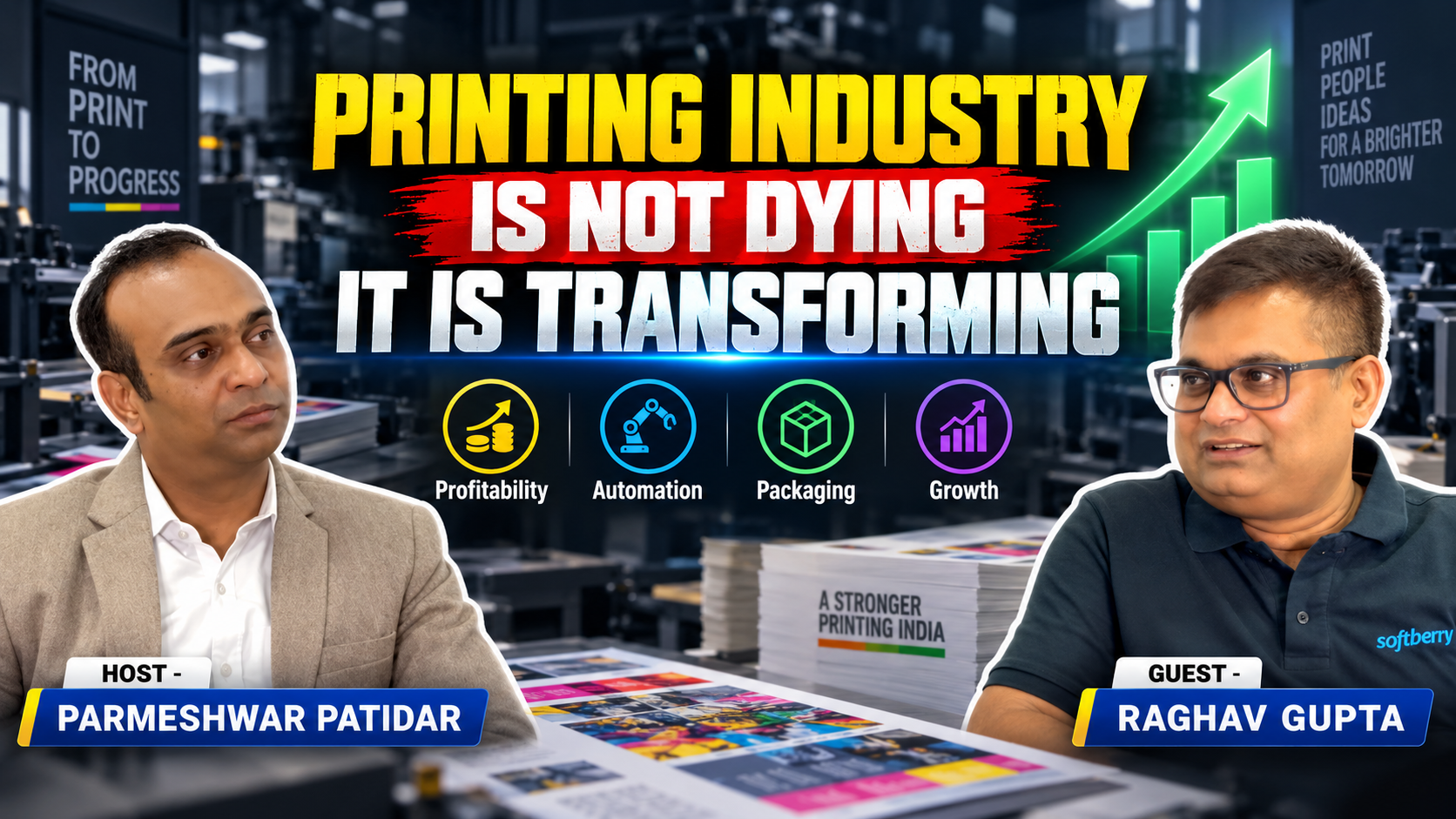
The Indian Printing Industry Is Not Dying — It Is Transforming
The printing industry in India is going through one of the most important transitions in its history.
For years, many printing businesses have focused heavily on machines, production capacity, pricing and execution. But the market is changing. Customers today expect faster response, better quality, customization, transparency, technology-enabled service and reliable delivery across multiple locations.
This means the future of printing will not be decided only by who owns the biggest or most advanced machine.
It will be decided by who can build the strongest business system around that machine.
In this insightful conversation, Parmeshwar Patidar, Profitable Print Business Coach, and Raghav Gupta, Founder & CEO, Softberry Technology, discuss the real challenges and opportunities facing printers, packaging companies and print entrepreneurs in India.
The discussion focuses on one important idea:
Printing is not disappearing. The traditional way of running a printing business is changing.
Why Are Many Printers Struggling With Profitability?
One of the biggest challenges in the printing industry is that revenue does not always translate into profit.
A printing company may have good machines, skilled operators and regular orders, but still struggle with cash flow and margins.
Why?
Because profitability depends on much more than production.
There can be leakages at multiple stages:
Enquiries may not be followed up properly. Quotations may be delayed. Pricing may not include all costs. Production errors may lead to rework. Material may be wasted. Vendor rates may not be monitored. Delivery delays may result in penalties. Payments may remain outstanding for months.
Individually, these may look like small operational problems. Together, they can significantly reduce profitability.
This is why printing businesses need to move from simply managing production to managing the complete business process.
Machines Alone Cannot Build a Scalable Business
Buying another machine is often seen as the natural solution for business growth.
But additional capacity only helps when there is enough demand to utilize that capacity profitably.
A machine is an important asset, but it does not automatically generate customers.
For sustainable growth, a printing business needs a combination of:
Demand generation + Efficient process + Correct pricing + Quality execution + Financial control
Without these elements, more machinery can sometimes increase fixed costs instead of increasing profits.
The mindset therefore has to change from:
“Which machine should I buy next?”
to:
“How can I generate more profitable demand and execute it efficiently?”
The Real Gap: Demand, Supply and Process
The printing ecosystem already has enormous production capacity.
Across India, there are thousands of offset printers, digital printers, screen printers, packaging manufacturers, signage companies, garment decorators, gifting suppliers and specialized production partners.
At the same time, corporations, retailers, startups, D2C brands and institutions generate huge demand for printing and branding products.
The problem is not always the absence of demand or production capacity.
The bigger challenge is connecting the two efficiently.
This creates three critical areas:
Demand: Who generates the business?
Supply: Who has the right capability to manufacture it?
Process: How are enquiry, quotation, artwork, production, quality, dispatch, invoicing and payment managed?
When these three elements work together, the industry can operate far more efficiently.
Automation Can Reduce Business Leakages
Another major topic in the conversation is automation.
As printing businesses grow, manually managing enquiries, Excel sheets, WhatsApp conversations, quotations, production updates, vendor coordination, dispatch and payment follow-ups becomes increasingly difficult.
Information gets missed.
Follow-ups are delayed.
Responsibilities become unclear.
Important project details remain inside personal chats.
Management does not get real-time visibility.
Automation can help businesses create a structured workflow from enquiry to payment.
For example:
Enquiry → Requirement Validation → Costing → Quotation → Order Confirmation → Production → Quality Check → Dispatch → Invoice → Payment → Feedback
When every stage has an owner, timeline and status, management gains far better control over operations.
Technology should therefore not be viewed merely as software.
It should be viewed as a way to create discipline, visibility and scalability.
Pricing Is One of the Most Important Skills in Printing
Many printing businesses compete primarily on price.
But being the cheapest supplier is rarely a sustainable strategy.
A quotation must consider not only raw material and machine cost but also:
production wastage, artwork, manpower, packaging, logistics, installation, quality inspection, credit cost, rework risk and administrative overhead.
If these costs are ignored, a project that appears profitable during quotation may actually generate very little margin.
Good pricing does not mean charging the highest price.
It means understanding the true cost of execution and maintaining a sustainable margin while delivering value to the customer.
That is why one of the simplest formulas discussed for building a profitable print business is:
Demand Generation + Process Automation + Right Pricing = Sustainable Profitability
Packaging and D2C Brands Are Creating New Opportunities
Printing is also expanding far beyond traditional commercial printing.
The rapid rise of packaging, e-commerce, retail, food brands, cosmetics, pharmaceuticals and D2C businesses is creating continuous demand for printed and branded products.
Every growing consumer brand requires multiple print touchpoints:
product packaging, labels, cartons, inserts, promotional material, retail displays, signage, shipping boxes and branded merchandise.
And unlike many traditional printing jobs, packaging demand is often repetitive.
As brands grow, their printing requirement grows with them.
This creates a major opportunity for printing companies that can provide quality, consistency, speed and scalable execution.
Collaboration Could Become the Future of Printing
Traditionally, printers often try to manufacture everything themselves.
But the market is becoming increasingly specialized.
One printer may be excellent at offset printing.
Another may specialize in corrugated packaging.
Someone else may have strong digital printing capability.
Another may specialize in signage, textile printing, gifting or fabrication.
Instead of investing in every possible technology, businesses can build strong production networks.
This creates an asset-light model where companies focus on their strengths and collaborate with reliable production partners for other requirements.
The industry can therefore move from:
Competition only
to:
Competition + Collaboration
This is particularly important for businesses that want to serve corporate clients across multiple cities.
No single production unit can practically specialize in every category and every geography.
A trusted network of partners, supported by standardized processes and technology, can provide much greater scalability.
From Printer to Procurement and Solution Partner
Another major transformation is taking place in how customers view printing suppliers.
Corporate buyers increasingly prefer fewer vendors who can manage multiple categories.
Instead of coordinating separately with a printer, packaging supplier, signage vendor, gifting agency and apparel manufacturer, they may prefer one reliable partner capable of managing the complete requirement.
This creates an opportunity for printers to evolve beyond being manufacturing vendors.
They can become:
Printing partners
Brand execution partners
Packaging solution providers
Procurement partners
Technology-enabled fulfilment partners
The value shifts from simply manufacturing a product to managing the customer's requirement from beginning to end.
Operators vs Business Owners
Perhaps the most important question from the conversation is:
Will printers remain operators, or become scalable business owners?
An operator focuses primarily on production.
A business owner focuses on the complete system.
That includes sales, marketing, customer acquisition, pricing, process, technology, team development, vendor management, cash flow, profitability and expansion.
Production excellence remains extremely important.
But it becomes one part of a much larger business model.
Printers who develop strong business systems can gradually reduce their dependence on the owner for every decision.
And that is when the organization starts becoming scalable.
The Next Generation of Printing Businesses
The next generation of successful printing companies may look very different from traditional printing units.
They may combine:
strong manufacturing capabilities,
a nationwide vendor ecosystem,
centralized procurement,
digital enquiry management,
automated quotations,
CRM-driven project execution,
quality control systems,
real-time order tracking,
multi-location production,
technology-enabled customer communication,
and data-driven decision making.
Businesses that successfully integrate these capabilities can serve much larger customers without increasing complexity at the same rate as revenue.
A Major Opportunity Lies Ahead
India continues to have enormous potential in printing, packaging, branding and customized manufacturing.
As businesses expand, organized retail grows and new brands enter the market, the requirement for professionally managed printing and packaging will continue to evolve.
The opportunity is therefore not simply about printing more.
It is about building better printing businesses.
Businesses that understand customer demand, create efficient systems, maintain healthy pricing, use technology and build strong collaborative networks will be better positioned to capture the next phase of growth.
The printing industry is not dying.
It is moving from machines to systems.
From production to solutions.
From vendors to partners.
From local execution to scalable networks.
And from simply printing products to building professionally managed businesses.
The biggest opportunity for the next decade may therefore belong not necessarily to the printer with the largest factory, but to the entrepreneur who can connect:
Demand + Technology + Process + Production Network + Profitability.
For printers, packaging entrepreneurs and industry professionals, the message is simple:
Do not only improve your printing capability. Improve your business capability.
That transformation could define the future of the Indian printing industry.
Recent Posts
Why Indian Printing Needs a New Business Model | Raghav Gupta (Softberry) & Parmeshwar Patidar

How to Grow Your Small Business with Signage & Flex Services During Diwali 2026

The Ultimate Guide to Signage & Flex Services in 2026: Mastering Visibility and Growth




Ordering with Softberry is simple and effortless-


